

Child mobile phone
Christine refused to give her daughter, Léa, a phone for as long as possible . Then, for her 13th birthday, she received a smartphone as a gift from her godfather. She was the last of her friends to have her own phone. To explain this refusal, Christine says that she did not want the massive use of screens to absorb too much of her daughter's life. And now that she got her smartphone, Léa is on her phone a lot, constantly sending messages on Snapchat, Instagram, Facebook, WhatsApp.
Léa's parents fear a phenomenon of digital dependence in their daughter, which deprives her of doing other activities that she previously enjoyed.
This example illustrates the discomfort that parents may feel about the issue of the telephone and the child . Does this mean that we should prevent children from having a phone, or more broadly, from going near screens? The answer is obviously no. Today, digital is everywhere. It has become part of our customs and accompanies us in many of our daily activities.
Preventing your child from using screens means cutting them off from a part of society. It's not for nothing that we talk of a new phenomenon: “Digital exclusion” for the most deprived. A Médiamétrie study showed that the average age of the first mobile phone among French children was 11 years old. We must therefore help them from an early age to understand this new tool and support them so that they learn to use it properly.
As we teach our children to behave well in society, we must show them how to properly use and behave with a smartphone , on the internet and on the different applications and social networks that they are very fond of. But all this is learned step by step.

From 4 to 6 years old
It is strongly recommended for young children to Prohibit the use of telephones and other mobile devices . As for exposure to screens, such as television, it should be less than an hour per day for children aged 2 to 5 . And for children under 2 years old, they should not be exposed to screens at all .
It must be understood that the use of smartphones from a very young age harms proper brain development . Mobile devices quickly accustom the brain to their use through the production of dopamine, better known as the pleasure hormone. The constant stimulation of the brain generated by screens causes “brain shocks”. This results in a phenomenon of rapid dependence among the little ones.
We are not saying that mobile devices or screens more broadly are harmful to children. It's how we use them that is . Exposure to digital technology at too young a age disconnects the child from the basic needs necessary for their proper development: eating, sleeping, physical activity, play, imagination and concrete experimentation with physical objects.
If young children become accustomed to screens, the brain loses its ability to get its dose of dopamine. Why go play, go outside, make friends to get dopamine since you can get it easily with your screen?
Accustoming children to mobile devices does not allow them to socialize . It is important that the child meets, plays, exchanges with others, looks at their faces to develop empathy, learns to read emotions, understands social interactions and the functionalities of objects. Social skills develop through contact with other people and physical knowledge during experiments.
From 7 to 9 years old
For this age group, it is not recommended at all to give your child a smartphone. Although they are becoming more and more curious and it is more and more difficult to restrict their access to your own phone so that they can play Clash Royale, Bubble Witch or Pokémon Go.
The same goes for using social media . Between 7 and 9 years old, They are still too young to go there . At this age, it is difficult to understand the permanent publication system. Children under 13 have not yet developed critical thinking skills. Exposure to the flood of daily publications and messages can be a source of stress for the child.
Exposure to screens for this age group must also be supervised by parents. Children aged 5 to 11 should not spend more than 2 hours a day in front of the television, PC, tablet or smartphone.
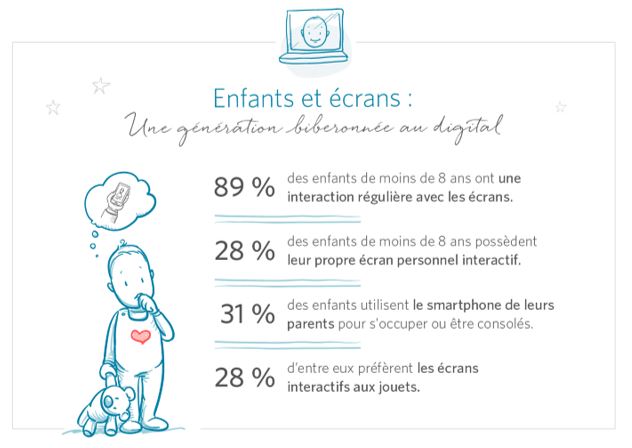
Infographic from the study of faireparterie.fr about digital uses among young parents and their children.
From 10 to 12 years old
Parents should always limit phone use at this age, as well as any internet-connected devices. Children can start to have their own device, but Smartphones connected to the Internet should be avoided .
Mobile devices and the use of social networks by children of this age can cause emotional disturbances . In particular, they promote excessive confidence in children who constantly feel valued by the likes, hearts, shares, flames on their publications and messages. Or, conversely, an unjustified depreciation of his person in relation to the other children. Which can be harmful for establishing the necessary self-confidence.
Reality shows that children get their first smartphone at the average age of 11 years old. It's then difficult not to give in to the pressure from your child who explains that all his friends have one. Instead of strictly banning smartphones and social networks, we must support the child in their first uses.
As soon as the child begins to use smart devices connected to the Internet, Parental controls must be put in place . There are many tools, software or applications for this, the best known Family Link for example. Parents should not feel overwhelmed by a game or technology. Then ask your child to explain to you so that you can immerse yourself in their world.
Preteens and teens from 12 years old
Ideally, it would be recommended to push the age of first phone back to 16 . But, it is becoming very difficult to respect this principle nowadays. Regardless, it is important to monitor your teenager for possible changes in behavior . A teenager who develops a digital addiction is more susceptible to depression or anxiety.
On social networks, during the first years, teenagers should not only exchange with the friends they have in real life . HAS At this age, social networks are favorable for strengthening friendships. Your child will feel too monitored if you ask him for his personal access. On the other hand, you can very well ask that he add you as a “Friend” on Facebook and other platforms. This won't control everything but you will at least see the messages that are public. And you also have to start having confidence in your teenager, while keeping an eye on them . 😉
Use of the telephone must always be supervised by an adult . HAS At each stage of development, mom and dad must teach the child the right actions, what to do and what not to do, and to be careful. Just as we teach our children not to talk to strangers on the street, we don't accept an invitation from someone we don't know on social media.
The best alternative solution remains the connected watch for children which allows them to make calls while having a fashionable connected gadget.
To go further on this question of using screens with children, we can recommend this book: “How to use screens as a family” , by Elena Pasquinelli, philosopher, researcher in cognitive sciences, member of the Scientific Council of the 'National Education. In this book you will find explanations on the impact of mobile devices on children's brains. Drawing on the latest research in neuroscience and cognitive science, the researcher explains very clearly the mechanisms of the brain when it is exposed to screens.


